
Preparing for remote IT job interview questions requires more than reviewing technical definitions. Employers want to understand how you solve technology problems, communicate with coworkers, manage your responsibilities, and perform effectively when your team isn’t working in the same office. A remote IT interview may include technical troubleshooting questions, real-world scenarios, behavioral questions, and discussions about your home working environment. Depending on the position, you might also complete a practical assessment or explain a previous project. This guide covers common remote technology interview questions, realistic sample answers, technical topics worth reviewing, and practical advice to help you prepare confidently.
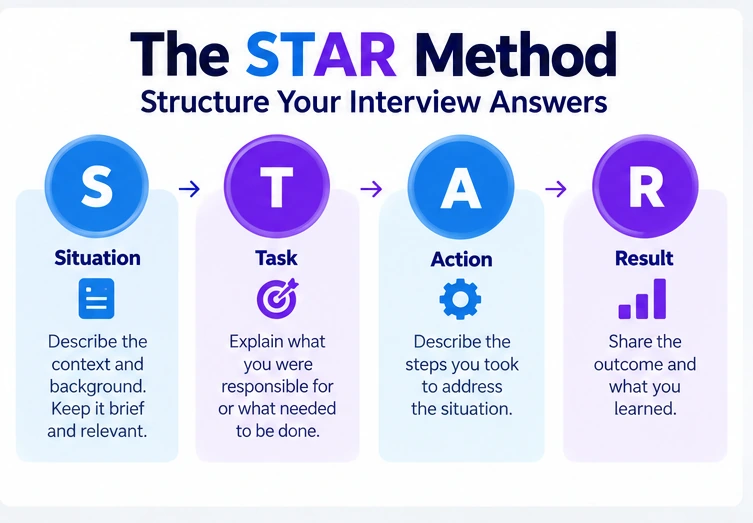
Table of Contents
What to Expect During a Remote IT Job Interview
A remote IT job interview is a hiring conversation conducted through video, telephone, or another online communication platform to assess your suitability for a technology position. Employers typically evaluate your technical knowledge, practical experience, problem-solving approach, communication skills, and ability to work independently. For example, an IT support applicant may be asked how to troubleshoot an internet connection, while a software developer might be asked to describe debugging techniques or explain a recent project.
Remote employers may also ask how you handle deadlines, coordinate with teammates across time zones, and communicate when you encounter unexpected problems. The interview process differs between companies. Some use an initial recruiter screening followed by technical and behavioral interviews, while others include practical tasks or portfolio reviews. Understanding the job description helps you identify which areas deserve the most preparation.
Common Remote IT Job Interview Questions and Answers
The following questions are useful for entry-level and experienced applicants preparing for remote technology positions. The sample answers are examples of how to structure a response, not scripts that should be memorized word for word.
1. Tell Me About Yourself
This is often an opening question. Interviewers want a concise introduction connecting your background, relevant abilities, and career goals to the position.
Sample answer:
“I’m an IT professional with an interest in technical troubleshooting and software support. I’ve developed skills in identifying common technical problems, documenting solutions, and communicating clearly with users. I’m particularly interested in this position because it would allow me to apply those skills while contributing to a distributed technology team.” Adapt the answer to your actual experience. If you’re a beginner, mention relevant courses, projects, internships, or transferable experience instead of claiming professional work you haven’t completed.
2. Why Do You Want to Work Remotely?
Employers ask this question to understand whether you’re prepared for the responsibilities of working independently. A strong response emphasizes productivity, communication, and effective collaboration rather than focusing entirely on convenience.
Sample answer:
“Remote work appeals to me because I can organize focused working time while staying connected with colleagues through digital communication tools. I understand that remote teams depend on clear updates, accountability, and timely communication. I’m comfortable following structured workflows and documenting my progress so other team members know what’s happening.” Avoid implying that remote work means reduced responsibilities or unlimited flexibility.
3. How Do You Prioritize Multiple IT Tasks?
Technology professionals frequently handle competing requests, including urgent incidents, routine maintenance, and project-related work. Interviewers want to understand how you decide what to address first.
Sample answer:
“I evaluate tasks according to their urgency, business impact, and deadlines. If a critical service affects multiple users, I would prioritize restoring that service before handling routine requests. I would also communicate expected progress and update the relevant tickets so stakeholders understand what is being addressed.”
This response demonstrates organized thinking and awareness of business priorities.
4. How Do You Troubleshoot an Unfamiliar Technical Problem?
Technical troubleshooting questions evaluate your reasoning rather than simply testing whether you’ve memorized a particular solution.
Sample answer:
“I begin by gathering information about the issue, including symptoms, recent changes, and the affected environment. Then I try to reproduce the problem and investigate the most likely causes. I test potential solutions systematically, document the results, and verify that the issue has been resolved. If necessary, I escalate the problem with clear troubleshooting notes.”
Employers often appreciate a structured approach that reduces unnecessary guesswork.
5. How Do You Communicate With Remote Team Members?
Remote collaboration relies heavily on written updates, virtual meetings, and shared documentation. Interviewers may want evidence that you can communicate effectively without constant supervision.
Sample answer:
“I use clear written updates to explain completed tasks, current priorities, and blockers. For urgent problems, I use the communication channel established by the team. I also document important decisions so colleagues working in different time zones can understand the context and continue their work.”
If you have real experience collaborating through Slack, Microsoft Teams, Jira, or similar tools, describe it briefly.

6. Describe a Difficult Technical Problem You Solved
This behavioral question allows you to demonstrate practical problem-solving. A useful way to structure your response is the STAR method: Situation, Task, Action, and Result. Explain the technical problem, what you were responsible for, how you investigated it, and what happened afterward. For example, you might describe identifying a configuration issue that prevented an application from connecting to a service. Be specific about your contribution and avoid claiming results you cannot support. If you don’t have professional IT experience, an academic project or personal testing exercise can still provide a relevant example.
7. How Do You Stay Productive While Working From Home?
Employers want to know whether you can manage responsibilities when colleagues and managers aren’t physically nearby.
Sample answer:
“I start by reviewing my priorities and identifying the tasks that need attention. I use a task management system to track progress and allocate focused time for technical work. I also communicate early if a blocker affects my schedule, rather than waiting until a deadline.”
This demonstrates independence without suggesting that remote employees should work without support.
Technical Interview Questions for Remote IT Support Jobs
Technical support positions often involve identifying problems with devices, software, networks, accounts, and business applications.
You don’t necessarily need to know every technical answer, but you should be able to explain a sensible troubleshooting process.
8. What Would You Do If a User Couldn’t Connect to the Internet?
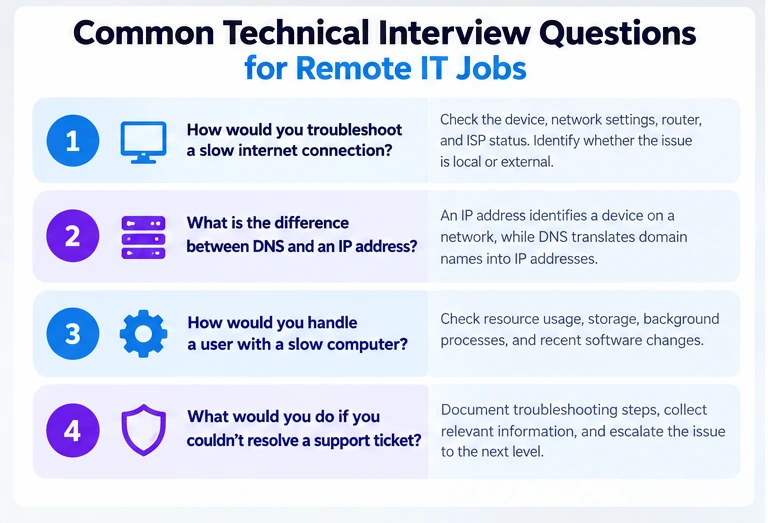
A good answer begins by determining the scope of the problem. You might check whether other devices are affected, confirm the user’s connection status, review Wi-Fi or Ethernet settings, and investigate whether the issue involves the device, local network, or external service. The important part is explaining how you narrow down the possible causes. For a remote support position, also describe how you would guide a user through troubleshooting when you cannot physically access their device.
9. What Is the Difference Between DNS and an IP Address?
An IP address identifies a network interface or endpoint within an IP network, while the Domain Name System (DNS) helps translate human-readable domain names into information such as IP addresses.
For example, when someone enters a website address, DNS may help the device locate the server associated with that domain.
Interviewers may ask this question to evaluate basic networking knowledge.
10. How Would You Handle a User Who Reports a Slow Computer?
Start by asking when the problem began and whether it affects one application or the entire system. Then investigate factors such as resource usage, available storage, background processes, recent software changes, and possible security concerns Explain that you would follow company troubleshooting procedures, avoid making unauthorized changes, and confirm whether the user’s performance has improved.
11. What Would You Do if You Could Not Resolve a Support Ticket?
Sample answer:
“I would document the troubleshooting already performed, collect relevant error information, and escalate the issue through the appropriate support process. I would keep the affected user informed and cooperate with the specialist handling the next stage.” This demonstrates accountability and a willingness to collaborate rather than guessing at an unsafe solution.
Remote Teamwork and Behavioral Interview Questions
Technical knowledge matters, but employers also need people who can work productively across different locations.
12. How Do You Handle Working Across Different Time Zones?
Sample answer:
“I keep shared documentation updated, communicate deadlines with clear time-zone information, and complete tasks in a way that allows colleagues to continue their work asynchronously. If something requires an immediate discussion, I coordinate a suitable overlap period.” The goal is to show that you’re considerate of others’ schedules while maintaining reliable communication.
13. What Would You Do if a Teammate Disagreed With Your Technical Approach?
A strong response should demonstrate professionalism and openness. You could explain that you would ask questions to understand their concerns, compare the approaches against project requirements, and consider evidence from testing or documentation. If the disagreement remains unresolved, you would follow the team’s decision-making process. Employers generally want candidates who can discuss technical disagreements constructively rather than treating them as personal conflicts.
14. How Do You Handle an Unexpected Deadline?
Sample answer:
“I would review the remaining work, identify the highest-priority deliverables, and communicate any risks early. If the deadline cannot reasonably be met without reducing scope or quality, I would discuss the available options with the responsible team members.” This answer demonstrates realistic planning and transparency.
Role-Specific Remote Tech Interview Questions
Different IT positions require different technical preparation. Reviewing relevant questions helps you focus on your target career rather than studying unrelated subjects.
| IT Role | Common Interview Topics |
| IT Support Specialist | Troubleshooting, networking, operating systems, ticket handling |
| Software Developer | Debugging, programming fundamentals, testing, version control |
| QA Tester | Test cases, bug reporting, regression testing, test scenarios |
| Cloud Engineer | Cloud services, security, networking, monitoring |
| Cybersecurity Analyst | Access control, incident response, security alerts, risk |
| DevOps Engineer | CI/CD, deployment, monitoring, automation, infrastructure |
For example, a remote QA tester may be asked how to test a login page or document a defect. A cloud engineer might be asked how to investigate a service outage or manage access permissions. The best preparation comes from reviewing the actual job description and practicing tasks related to the employer’s technology stack.
How to Prepare for a Virtual Tech Interview
A virtual interview requires both professional preparation and a reliable technical setup. Begin by researching the company and reviewing the job description. Identify the main technologies mentioned and prepare examples that demonstrate your relevant experience. Test your internet connection, camera, microphone, and meeting application before the interview. Choose a quiet environment with sufficient lighting and a reasonably uncluttered background. Keep your resume, portfolio, and project notes accessible in case the interviewer asks you to explain previous work.
You should also prepare a backup communication method in case your internet connection fails. During the conversation, listen carefully and pause briefly before answering when there is audio delay. Avoid reading prepared responses directly from another screen. Natural conversation usually communicates your knowledge more effectively than memorized scripts. If an interviewer gives you a practical problem, explain your approach clearly rather than silently attempting to produce an answer.
How to Answer Interview Questions Using the STAR Method
The STAR method helps structure answers to questions about previous challenges, teamwork, or achievements. Start by explaining the Situation and the circumstances surrounding the problem. Then describe the Task, including your responsibility. Next, explain the Action you personally took. Finally, share the Result, focusing on the actual outcome and anything you learned. For example, if you’re asked about a technical issue you resolved, you might describe a website malfunction, your responsibility for investigating it, the tests you performed, and how the problem was eventually addressed. The method helps you avoid vague statements while keeping the answer focused on relevant experience.
Questions You Should Ask a Remote IT Employer
An interview is also your opportunity to evaluate whether a position suits your professional needs. You might ask how the team communicates across time zones, which tools support project management, and what successful performance looks like during the first few months.
For technical positions, you can ask about the existing technology stack, documentation practices, escalation procedures, and opportunities for professional development. It’s also reasonable to clarify the role’s location requirements, expected working hours, equipment arrangements, and whether the position is fully remote.
These questions demonstrate interest while helping you understand the practical requirements before accepting an offer.
Common Mistakes to Avoid in Remote IT Interviews
One mistake is preparing only for technical questions while ignoring communication and teamwork scenarios. Another is exaggerating experience with tools or technologies. If you haven’t used a particular platform professionally, explain what you understand and describe any relevant practice projects honestly. Some candidates also overlook basic interview preparation, such as checking their microphone or confirming the correct meeting time. Avoid giving long answers that don’t address the actual question. When describing technical issues, explain your reasoning clearly and support claims with examples. Finally, avoid treating remote work as an opportunity to avoid structure or accountability. Employers still expect reliable communication, performance, and collaboration.
Frequently Asked Questions
What are the most common remote IT job interview questions?
Common questions cover technical troubleshooting, previous projects, time management, remote collaboration, communication, problem-solving, and motivation for remote work.
Are remote IT interviews harder than in-person interviews?
Not necessarily. The technical expectations may be similar, but remote interviews also require familiarity with virtual communication tools and the ability to explain your work clearly online.
How should beginners prepare for a remote IT interview?
Review foundational technical concepts, practice troubleshooting scenarios, prepare examples from relevant projects, and research the employer’s requirements.
Do remote IT interviews include technical tests?
Some do. Depending on the role, employers may use troubleshooting exercises, coding assessments, testing scenarios, portfolio reviews, or other practical evaluations.
What should I wear for a virtual IT interview?
Choose neat, professional clothing appropriate to the employer and position. Also consider lighting and camera framing so you appear clearly on screen.
How do I answer questions about remote work experience?
Describe genuine examples of independent task management, online communication, documentation, and collaboration. Academic or personal projects may also demonstrate relevant skills.
What should I do if my internet disconnects during an interview?
Attempt to reconnect promptly and contact the interviewer through an agreed backup method. Briefly explain the issue and ask whether the conversation can continue by telephone or be rescheduled.
Final Thoughts
Preparing for remote IT job interview questions means developing both technical knowledge and the ability to explain how you work with others. Practice realistic troubleshooting scenarios, prepare examples of completed projects, and think carefully about how you manage tasks, communicate problems, and collaborate remotely. You don’t need to memorize perfect answers. Clear reasoning, honest examples, and relevant preparation can help you present your abilities confidently.When you’re ready to explore your next opportunity, visit Remote IT Jobs and review positions that match your skills, experience, and preferred working arrangements.