Most IT professionals leave money on the table in salary negotiations. Not because they lack skills. Not because they asked for too much. Because they accepted the first number without saying a word. If you’re figuring out How to Negotiate Salary for Remote IT Job in 2026. the first thing to understand is that negotiation is expected. Hiring managers build room into offers specifically because they know candidates will push back. When you don’t — they keep the extra budget. It’s that simple.
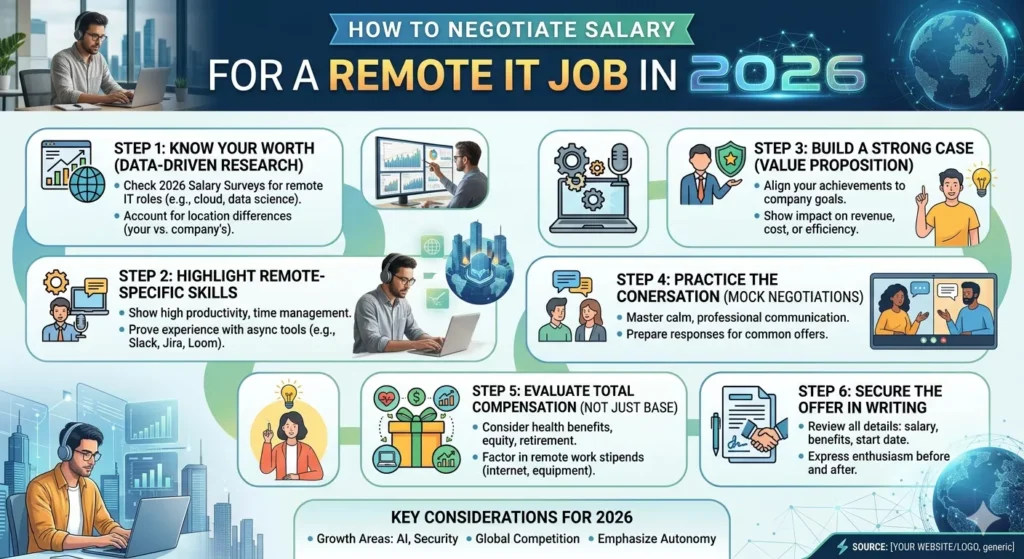
Remote IT roles add a layer to this. Location-based pay differences, timezone adjustments, equipment stipends, async work premiums — there are more variables on the table than a standard in-office offer. Knowing which ones to push on and how to frame it matters more than most guides tell you. Here’s the full breakdown. Also Read: How to Check WordPress Cron Jobs?
Table of Contents
Why Remote IT Salaries Have More Room Than People Realize
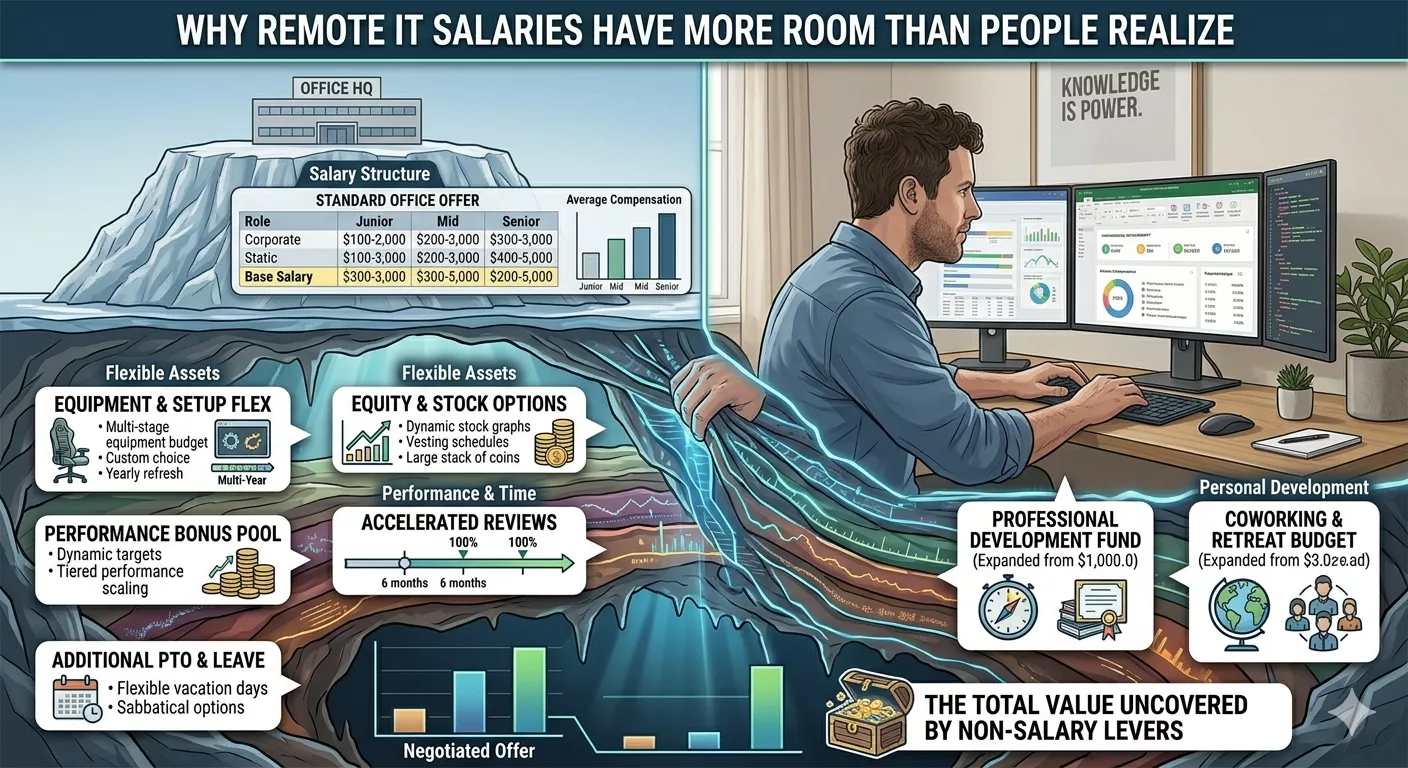
Understanding how to negotiate salary for remote IT job offers starts with understanding how remote compensation actually works. Companies hiring remotely pull from a wider talent pool. That sounds like it should drive salaries down — more candidates, more competition. In practice for skilled IT roles, it does the opposite. A company in Kansas City that couldn’t previously hire a senior DevOps engineer locally can now compete for that person against companies in San Francisco and New York. To win that talent, they often pay above their local market rate.
At the same time, companies that used to pay San Francisco rates are now hiring remote workers in lower cost-of-living areas and adjusting pay downward using geographic differentials. Both things are true simultaneously depending on the company and the role.
What this means for negotiation: the range is wider than it was for office roles. The floor and ceiling for the same job title can vary by $40,000 to $80,000 depending on the employer’s compensation philosophy. Knowing where a specific company sits in that range before you negotiate is the most valuable research you can do.
Do This Before You Respond to Any Offer
Most people respond to a salary offer within hours. That’s too fast.
When you receive an offer, it’s completely professional to say: “Thank you! I’m genuinely excited about this opportunity. Can I take a day or two to review everything before getting back to you?” No employer rescinds an offer because someone asked for 48 hours to think. If they do, that tells you something important about the company. Use that time to do three things:
Research the real market rate. Levels.fyi is the most reliable source for tech compensation data in 2026, especially for software engineers, DevOps, data engineers, and product roles. It shows total compensation broken down by base salary, equity, and bonus — not just base. Glassdoor and LinkedIn Salary are useful for cross-referencing but tend to skew lower than actual compensation because people underreport. Blind is useful for current employee reports from specific companies.
Check the company’s compensation band. Some companies post pay bands publicly. Many don’t. But job postings in jurisdictions with pay transparency laws — Colorado, New York, California, Washington — often include salary ranges. If the company has posted similar roles in those states, the range is probably on their careers page. That number tells you the ceiling they’ve already approved for the budget.
Calculate your total compensation ask, not just base. Remote IT roles often include equity, annual bonuses, equipment budgets, home office stipends, and learning and development allowances. A $120K base with $15K in annual bonus and $10K in equity vesting is worth more than a $130K base with nothing else. Know what you’re comparing before you counter.
The Number You Name First Anchors the Whole Conversation
There’s a real negotiation principle behind this. Whoever names a number first sets the reference point for everything that follows. It’s called anchoring and it works whether you intend it to or not. In most IT salary negotiations, the company names a number first through the offer. But sometimes recruiters ask for your salary expectations before making an offer — during the screening call, in the application form, or in early interviews. If they ask before an offer is made, there are two ways to handle it:
Deflect: “I’m flexible depending on the full compensation package — base, equity, and benefits together. I’d rather discuss that once we’re both confident there’s a mutual fit for the role.” This keeps you out of the anchoring trap without being evasive.
Give a range: If they press — give a range where your target is the bottom number, not the middle. If you want $130K, say $130K to $145K. People anchor to the low end of ranges. If you say $120K to $135K wanting $130K, you’ll likely land at $120K.
When you’re responding to an actual offer — counter with a specific number, not a range. Ranges invite the employer to pick the bottom. A specific counter like $138,000 signals that you’ve done your research and know what you’re worth. Also Read: How to Follow Up After a Job Interview
How to Actually Counter an Offer Without Feeling Awkward About It
This is where most people freeze. The offer is sitting there. It’s decent. You don’t want to seem greedy. You don’t want to risk the offer being pulled.
Here’s the reality: no company pulls an offer because a candidate negotiated professionally. The rare cases where offers get pulled involve ultimatums, rudeness, or someone accepting and then coming back multiple times after the deal was already done. A simple, professional counter sounds like this:
“Thank you for the offer — I’m really excited about the role and the team. Based on my research and the market rate for this position, I was expecting something closer to [your number]. Is there flexibility to get there?”
That’s it. No lengthy justification. No apology. No list of reasons why you deserve more. One sentence with a specific number and one question. Then you stop talking. Silence after a counter is uncomfortable. Most people fill it by walking back their ask. Don’t. Wait for the response.
If they come back with something in between that’s a successful negotiation. If they say the number is firm, ask what else is flexible. Signing bonus, additional equity, an extra week of PTO, a higher equipment stipend, a six-month salary review instead of twelve months. Remote IT roles often have more non-salary levers than office roles because companies have more flexibility in how they structure remote compensation packages.

What Remote IT Roles Have That Office Roles Don’t — And How to Use It
When figuring out how to negotiate salary for remote IT job offers specifically these are the remote-specific variables worth pushing on:
Home office stipend. Most remote companies offer some version of this. The range varies wildly $500 one-time to $3,000+ setup budget plus monthly internet reimbursement. If it’s not in the offer, ask. If it is, ask if it’s negotiable or if there’s a recurring component.
Equipment. Some companies ship you a laptop and that’s it. Others let you choose from a list or reimburse up to a certain amount. If you need specific hardware for your work a high-spec machine, dual monitors, particular peripherals negotiate the equipment budget before you start, not after.
Timezone flexibility. This is underrated as a negotiation point for people in different timezones than the core team. If a US company is hiring you in a significantly different timezone and expects partial overlap with their working hours, that’s a real constraint on your schedule. It’s reasonable to ask for a premium on base salary to compensate for that flexibility.
Async-first culture premium. Not all remote is equal. A remote company that genuinely operates asynchronously where you own your hours and deliver on outcomes rather than being online 9 to 5 in their timezone is a different working arrangement than one that’s remote-in-name-only with mandatory video calls all day. If a company is genuinely async-first, that’s a perk worth acknowledging. If they’re not that’s a hidden cost on your time worth factoring into the number you ask for. Also Read: How Much Does SEO Cost? Complete Guide
Annual remote work budget. Some companies offer annual stipends for coworking space access, team retreats, or professional development. If these aren’t in the initial offer, ask whether they exist. A $2,000 annual learning budget adds real value and most candidates never ask about it.

The Mistake That Costs IT Professionals the Most in Negotiations
Accepting the counter-offer without pushing back once more. Here’s how it usually goes. You counter at $138K from a $125K offer. They come back at $130K. Most people say yes immediately relieved that they got something. But there’s almost always one more move available.
“I appreciate you coming up to $130K. I’m still a bit below where I was hoping to land at $138K — is there any flexibility on the signing bonus or an accelerated review at six months to revisit the base?”
You’ve already broken the ice on negotiation. They know you negotiate. Asking once more for a signing bonus or an accelerated review is completely within normal range and frequently works. A $5K to $10K signing bonus is cheap for a company compared to the cost of leaving a senior IT role unfilled for another month. Also Read: How to Filter Remote Jobs on Linkedin?
The candidate who stops at the first counter walks away with $130K. The one who asks once more often walks away with $130K plus $7,500 signing. Same conversation, one more sentence.
Numbers to Know Before You Negotiate Remote IT Salary in 2026
Remote IT compensation varies significantly by role and experience. These are realistic 2026 ranges for fully remote positions based on current market data:
| Role | Mid-Level Range | Senior Range |
|---|---|---|
| Software Engineer | $110K–$145K | $150K–$200K+ |
| DevOps / SRE | $115K–$150K | $155K–$210K+ |
| Data Engineer | $110K–$145K | $150K–$195K+ |
| Cybersecurity Analyst | $95K–$130K | $135K–$175K+ |
| Cloud Architect | $130K–$165K | $170K–$230K+ |
| Full Stack Developer | $100K–$135K | $140K–$185K+ |
| QA / Test Engineer | $85K–$115K | $120K–$155K+ |
| IT Project Manager | $90K–$120K | $125K–$160K+ |
These are base salary ranges. Total compensation including equity, bonus, and benefits typically runs 15 to 30 percent higher at companies that offer them. Always ask for the total compensation picture not just base, when evaluating any offer.
When to Walk Away
Knowing how to negotiate salary for remote IT job offers also means knowing when the number isn’t going to get there. If a company’s maximum offer is genuinely below market rate and they won’t move on any component of compensation base, signing bonus, equity, stipends that gap usually doesn’t close after you start. Compensation discussions are easiest before day one. After that, you’re working within their review cycle and whatever percentage increase is standard at that company.
A below-market offer that can’t be negotiated is worth walking away from if you have other options in play. The cost of accepting a $20K below-market salary compounds over time. Two to three years in, your next negotiation anchors off that lower number. Staying at market rate from the start matters more than the short-term comfort of accepting quickly.
How to negotiate salary for remote IT job offers comes down to research, timing, and being willing to ask. The market data exists. The room in most offers exists. The only thing that makes negotiation uncomfortable is the belief that asking is risky. It isn’t. Ask. Counter specifically. Push once more if they move but don’t quite get there. The worst realistic outcome is they say no and the offer stays where it was. The best outcome is a better number that follows you through every raise and negotiation that comes after. That’s worth a five-minute conversation.