

If you’re wondering how to find legit remote IT jobs in 2026, the safest way is to apply through the employer’s own careers page, use job boards that screen their listings, and verify every company before sharing personal details. A real employer never asks you to pay for anything, and never hires you through a chat app alone.
Remote IT jobs attract more fake listings than almost any other category. The pay is good, the work can be done from anywhere, and scammers know job seekers are motivated. If you’ve ever applied to a “Junior Developer, $50/hour, no experience needed” post and got a Telegram message ten minutes later, you’ve seen it firsthand.This guide covers where real remote tech jobs are posted, how to verify a company in about ten minutes, which red flags mean you should stop, and how to stand out once you find a role worth applying for.
The exact phrase “how to find legit remote IT jobs in 2026” now sits in the first sentence, which is where Rank Math looks for it. If you’d like the phrase in its capitalized form instead, you can use “How to find legit remote IT jobs in 2026 comes down to…” as the opening, but the version above reads more naturally. Read More
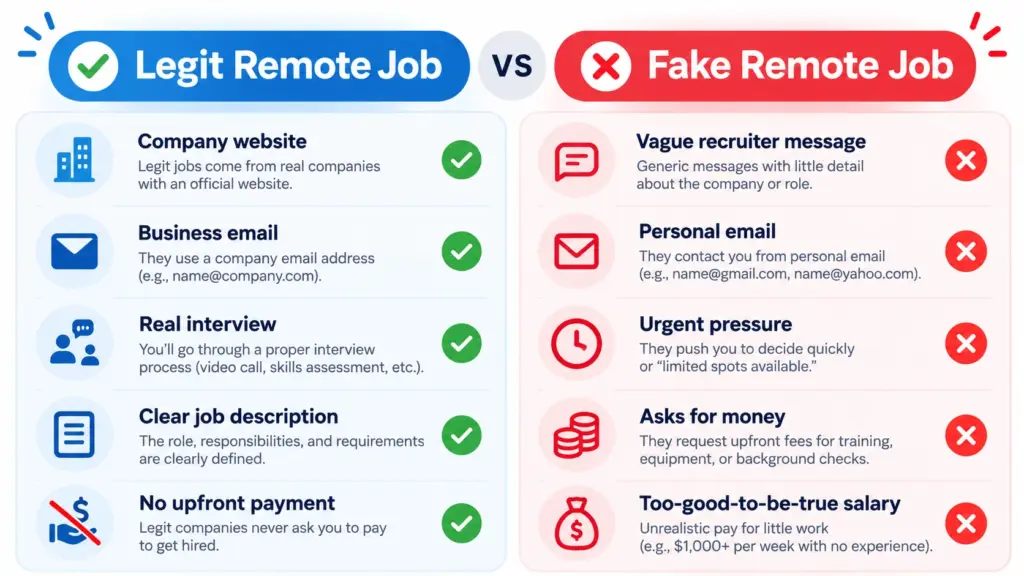
Table of Contents
Why Remote IT Jobs Attract So Many Scams
Scammers go where the volume is. Remote IT jobs draw thousands of applicants, listings are easy to copy, and candidates expect to do everything online. That last point is the problem: when a chat or video interview is normal, a fake one looks normal too.
Most fake postings aim for one of three things:
- Your identity. A fake “onboarding form” asks for your Social Security number, bank details, or ID scans before any offer exists.
- Your money. You’re asked to pay for training, software, a background check, or equipment.
- Your help moving money. You receive a check, buy equipment, and send funds onward. The check bounces, and you’re out the cash.
[FACT-CHECK] The FTC and the FBI’s Internet Crime Complaint Center publish current figures on job scams. If you want a statistic here, take it from their latest reports.
Where to Find Legit Remote IT Jobs
No source is 100% safe, but some are far more reliable than others.
Company career pages. This is the safest route. If you see a role on a job board, find the company’s official site and check whether the same listing appears there. If the company has no careers page, or the job exists nowhere but the board, treat that as a warning.
Curated remote job boards. Boards that review listings before publishing filter out a lot of junk. That’s the idea behind RemoteITJobs.us, which focuses on remote tech roles. Whichever board you use, check whether it explains how it vets employers. A board with no moderation policy lets anyone post anything.
LinkedIn. It’s useful because you can inspect both the recruiter and the company. Check how old the profile is, how many connections it has, and whether the person actually works where they claim. A recruiter profile created last month with a stock photo deserves suspicion.
Referrals and communities. Developer communities, open-source projects, local meetups, and Slack or Discord groups for your stack put you in front of people who know who’s hiring. A referral also lets you skip the open application pile, where scam listings thrive.
Freelance platforms, with caution. Upwork and similar sites can lead to contract-based work from home IT jobs in web development, QA, support, and DevOps. Keep communication and payment on the platform. If a client pushes you off-platform in the first conversation, walk away.
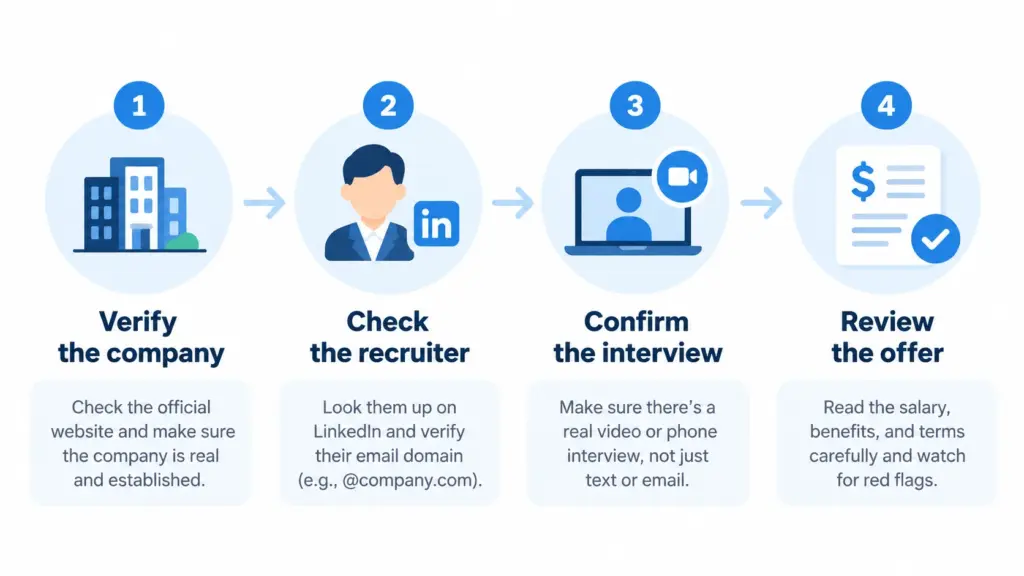
How to Verify a Remote Job Before You Apply
Most articles skip this part, but it’s what actually protects you. Run through these checks before investing time in an application.
Check that the company exists beyond the listing. Look for a real website, a business address, and consistent details across sources. Search the company name with “reviews” or “scam.”
Look up the domain. A “mid-sized software firm” whose website was registered three weeks ago is suspicious. A WHOIS lookup shows registration dates for most domains.
Match the email domain. A recruiter claiming to work for a major company but writing from Gmail is not a recruiter for that company. Watch for lookalike domains too, like a swapped letter or an extra word.
Confirm the recruiter. Find them on LinkedIn, then use the company’s official contact page to confirm they work there if anything feels off.
Search the job description. Paste a distinctive sentence into a search engine. If the same text appears under five different company names, it’s a template.
Read reviews critically. Glassdoor, Blind, and Reddit help, though small companies may have few reviews. Still, a company claiming 500 employees with no online footprint tells you something.
Sanity-check the pay. A rate far above the market for a junior role with minimal requirements is a classic lure. Compare against the Bureau of Labor Statistics or Levels.fyi.
Red Flags That Usually Mean a Remote Job Is Fake
One warning sign alone proves nothing. Two or three together should end the conversation.
- The interview happens entirely over text, often on Telegram or WhatsApp.
- You get an offer with no real interview, or after a very short one.
- You’re asked to buy equipment, pay a “processing fee,” or purchase software.
- You’re sent a check and told to deposit it and forward part of the money.
- The listing is vague about duties but specific about how much you’ll earn.
- “No experience needed” appears on a role that clearly requires technical skill.
- You’re pressured to accept quickly.
- Someone asks for your SSN, bank account, or passport before a signed offer.
- The company name on the offer letter differs from the one in the listing.
Real employers do collect sensitive information eventually, but only after a written offer, through a formal HR or payroll system, for tax and employment forms like the W-4 and I-9. Even then, confirm you’re dealing with the actual company first.
| Legit employer | Likely scam | |
| Interview | Video or phone call with named people | Text-only chat |
| Contact | Company email domain | Free email or lookalike domain |
| Money | Never asks you to pay | Fees, equipment purchases, check deposits |
| Job details | Clear stack, duties, team | Vague and generic |
| Hiring pace | Several rounds | Offer within hours |
Which Remote Tech Jobs Are Worth Targeting?
Some roles translate to remote work more naturally than others. Common remote-friendly categories include software and web development, QA and test automation, DevOps and cloud engineering, data analysis, IT support, technical writing, and project management for tech teams. Cybersecurity roles are often remote too, though some require on-site clearance.
Entry-level is the hardest part of the market and also where scams cluster. Real junior remote roles exist, but employers usually want proof of work: a portfolio, GitHub projects, internships, or certifications.
Remote IT Jobs USA: Location and Eligibility
Many “remote” roles still carry restrictions. A company may hire only in certain states because of tax registration or payroll compliance. Read the fine print for:
- Eligible states or countries. Some listings quietly exclude certain locations.
- Time zone expectations. “Remote” can mean “online during Eastern hours.”
- Work authorization. Many US employers can’t sponsor visas, and good listings say so plainly.
- Contractor or employee status. Contractors handle their own taxes and benefits. That’s fine for some roles, but it should be clear upfront and written into the offer.
How to Find Remote Jobs Hiring Now
“Remote jobs hiring now” is a popular search, and it can push you toward the loudest listings instead of the best ones. A few habits help.
Sort by newest, since fresh postings get fewer applicants and older ones are sometimes filled or abandoned. Set alerts on boards and LinkedIn using your stack and experience level. Apply early, but not blindly: a tailored application on day two beats a generic one in the first hour. Follow target companies directly, because many announce roles on their own channels before aggregators pick them up. And check the posting date. A listing untouched for months may be a “talent pool” post rather than an active opening.
How to Stand Out Once You Find a Real Opening
Finding a legit job is half the work. Getting hired is the other half.
Tailor your resume to the stack. Hiring managers skim fast. If the role mentions React, Node, and AWS, those should be visible near the top, backed by specific results rather than buzzwords.
Show you’re ready to work remotely. Employers worry about communication and self-direction. Mention async tools you’ve used, freelance or remote experience, and how you manage your time.
Build a small, real portfolio. One or two projects that solve an actual problem, with a clear README and a live demo, beat ten tutorial clones.
Keep your cover note short. Two or three specific sentences about why this company and this role are enough.
Prepare for the remote interview. Test your camera, audio, and connection beforehand. Expect questions about how you document work and handle blockers without a teammate nearby.
Ask questions that reveal legitimacy. Who would I report to? What does onboarding look like? How does the team collaborate? Real employers answer easily. Scammers dodge.
What to Do If You Think You’ve Been Scammed
Act fast, even if you feel embarrassed. Delay costs more than shame does.
- Stop all contact with the “employer.”
- If you shared bank details, call your bank immediately.
- If you shared your SSN or ID, consider a credit freeze and fraud alert.
- Report it to the FTC at ReportFraud.ftc.gov and to the FBI’s IC3.
- Report the listing to the platform where you found it.
- Change passwords on any exposed accounts.
Final Thoughts
Remote IT jobs are real and plentiful, but the search takes more skepticism than it used to. Stick to employers you can verify, use boards that screen their listings, and treat any request for money or early sensitive data as a stop sign. Do that consistently and finding legit remote IT jobs gets much less stressful.
If you want a place to start, browse the latest verified remote jobs on RemoteITJobs.us and apply directly to employers you’ve checked.
This runs about 1,500 words. The SEO title, meta description, FAQ, image suggestions, and other sections from the earlier version still apply. I can also trim or adjust anything if you’d like it closer to an exact count.